Learn how offshore staffing works, what it costs, which hiring models to consider, the benefits and risks to evaluate, and how to build a successful offshore team in 2027.
Offshore staffing has evolved beyond simply reducing labor costs. Businesses use offshore professionals to access specialized talent, increase operational capacity, support technology initiatives, extend working hours, and build flexible teams without establishing a physical presence in another country.
But offshore staffing is not a one-size-fits-all solution.
The right model depends on the role, level of control you need, skills required, working hours, security requirements, budget, and how closely the offshore professional needs to work with your existing team.
This 2027 guide to offshore staffing explains how the model works, compares the major hiring options, examines costs and benefits, outlines common risks, and provides a practical framework for choosing and managing an offshore team.
What Is Offshore Staffing?
Offshore staffing is the practice of hiring professionals who work from another country as part of your team. Depending on the arrangement, the professionals may work full-time or part-time and may be employed, supported, or managed through a staffing partner.
The key difference between offshore staffing and traditional outsourcing is the level of control.
With offshore staffing, you generally have greater involvement in:
- Selecting the professional
- Defining the role
- Assigning daily responsibilities
- Setting priorities
- Providing tools and processes
- Managing performance
- Communicating directly with the team member
With outsourcing, you typically contract a provider to deliver a defined service or business function.
Modern offshore staffing can cover roles across technology, marketing, creative services, customer support, sales, finance, administration, and other business functions.
For businesses looking for dedicated remote professionals, Elite Virtual Employee's remote staffing services provide staffing options across technology, digital marketing, and business support functions.
How Does Offshore Staffing Work?
The exact process varies by provider, but a typical offshore staffing model follows these steps.
Define the Role
Start by identifying:
- Responsibilities
- Required skills
- Experience level
- Working hours
- Time-zone requirements
- Software and tools
- Reporting structure
- Expected outcomes
- Security and access requirements
A specific role description makes candidate matching more effective.
Choose the Staffing Model
Decide whether you need:
- Full-time offshore staffing
- Part-time offshore staffing
- Direct sourcing
- Managed staffing
- Employer of Record (EOR) support
- Freelancers or contractors
The best option depends on how much control, flexibility, and operational support you need.
Source and Screen Candidates
A staffing provider may source candidates through its talent network, recruitment channels, referrals, or other sourcing methods.
Screening can include:
- Resume evaluation
- Skills assessment
- Technical or functional screening
- Communication assessment
- Experience verification
- Interviews
- Reference or background checks where appropriate
Interview and Select
The client should normally have an opportunity to interview shortlisted candidates and select the professional who best fits the role.
Complete Onboarding
Once selected, the professional is introduced to the client's systems, processes, team, tools, communication channels, and performance expectations.
Manage and Review Performance
Set clear KPIs and maintain regular communication.
Offshore employees should be treated as part of the operating team rather than simply as external resources.
What Are the Main Offshore Staffing Models?
There isn't one offshore staffing model that works for every company.
The most common models include:
Full-Time Offshore Staffing
A dedicated professional works full-time for your business.
This model is useful when you need consistent capacity and ongoing involvement.
Common roles include:
- Software developers
- Digital marketers
- Graphic designers
- Customer support specialists
- Virtual assistants
- Sales representatives
- QA professionals
- Finance and accounting professionals
For businesses looking for permanent or ongoing roles, EVE's Full-Time Hiring services offer a dedicated hiring model with sourcing, screening, interviews, onboarding, and ongoing support.
Part-Time Offshore Staffing
A professional works a defined number of hours rather than a full-time schedule.
This can work well for businesses that need specialized support but don't have enough workload to justify a full-time position.
Direct Sourcing
Direct sourcing gives the client greater involvement in finding and selecting offshore talent.
A staffing partner can support sourcing, screening, and shortlisting while the client maintains greater control over the selection process.
EVE's Direct Sourcing service uses proactive sourcing, screening, and shortlisting based on defined hiring requirements.
Managed Staffing
With managed staffing, the provider takes greater responsibility for recruitment, administration, team support, and other operational requirements.
This can be useful for businesses that want offshore talent without managing every administrative component themselves.
Employer of Record (EOR)
An EOR arrangement allows a third party to handle employment-related responsibilities in the country where the professional is located.
Depending on the arrangement, this can include payroll, employment administration, and local compliance responsibilities.
Businesses should understand exactly what the EOR provider handles and what remains the client's responsibility.
Offshore Staffing vs. Outsourcing
Offshore staffing and outsourcing are often used interchangeably, but they are not the same.
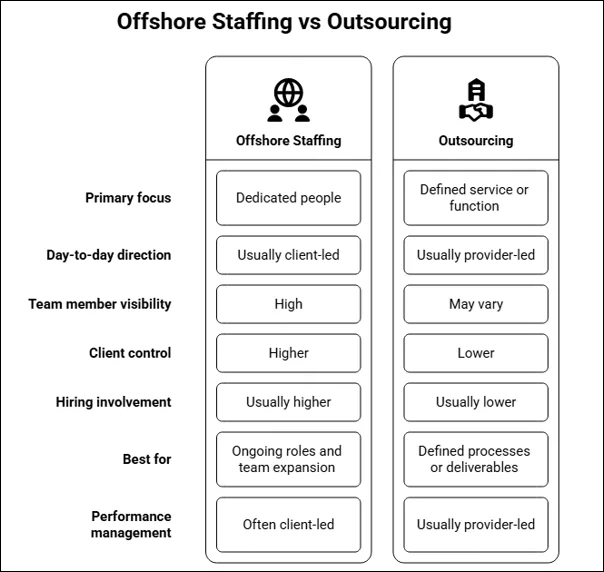
Choose offshore staffing when you want dedicated professionals who become an extension of your team.
Choose outsourcing when you want a provider to take responsibility for delivering a defined service or business process.
Offshore Staffing vs. Freelancers
Freelancers can be useful for short-term or project-based work, but they are different from dedicated offshore staffing.
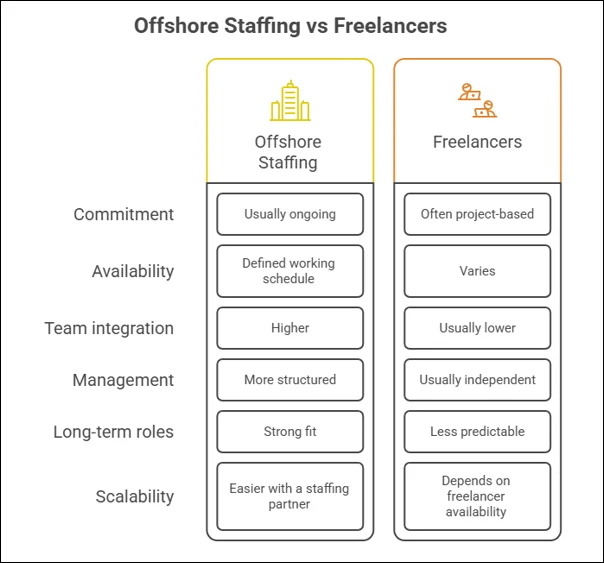
Freelancers can be appropriate for a specific project or specialized short-term requirement.
Offshore staffing is generally better suited to businesses looking to build ongoing capacity.
For a deeper comparison of remote staffing and freelance work, see EVE's guide to Remote Staffing vs. Freelancers.
Offshore Staffing vs. Local Hiring
The choice isn't simply between offshore and local employees.
The right model depends on the role.
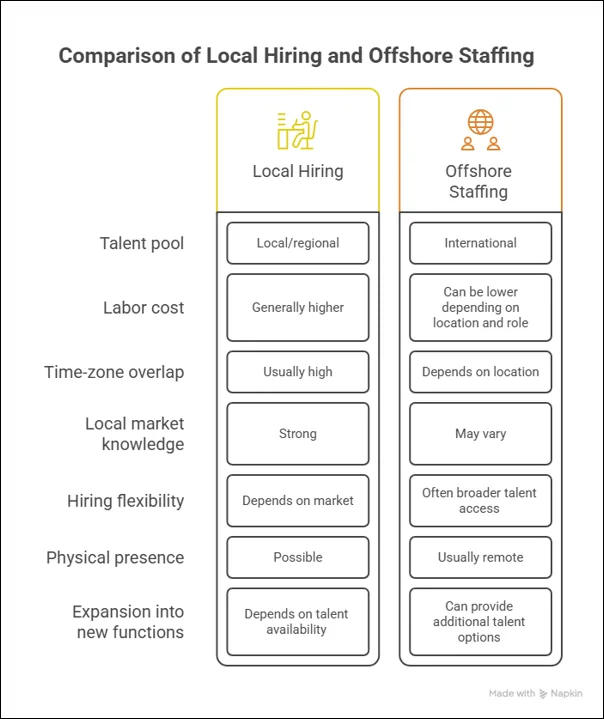
A business may use both models at the same time.
For example, a company might keep customer-facing leadership and location-specific roles local while using offshore professionals for technology, marketing, administrative, finance, or support functions.
How Much Does Offshore Staffing Cost in 2027?
There is no single offshore staffing price.
The total cost depends on:
- Role
- Experience level
- Technical specialization
- Location
- Full-time or part-time schedule
- Working-hour requirements
- Recruitment model
- Equipment
- Software
- Management support
- Payroll and employment services
- Compliance requirements
- Replacement terms
For this reason, businesses should avoid comparing only hourly or monthly rates.
Compare Total Cost of Ownership
A better comparison considers the full cost of each hiring model.
For a local employee, this can include:
- Base salary
- Employer payroll costs
- Benefits
- Recruitment expenses
- Office or workspace costs
- Equipment
- Software
- Training
- HR administration
- Management time
An offshore staffing arrangement may combine several of these costs into a predictable monthly fee, depending on the provider and agreement.
Example Cost Comparison
The following is an illustrative comparison, not a market quote.
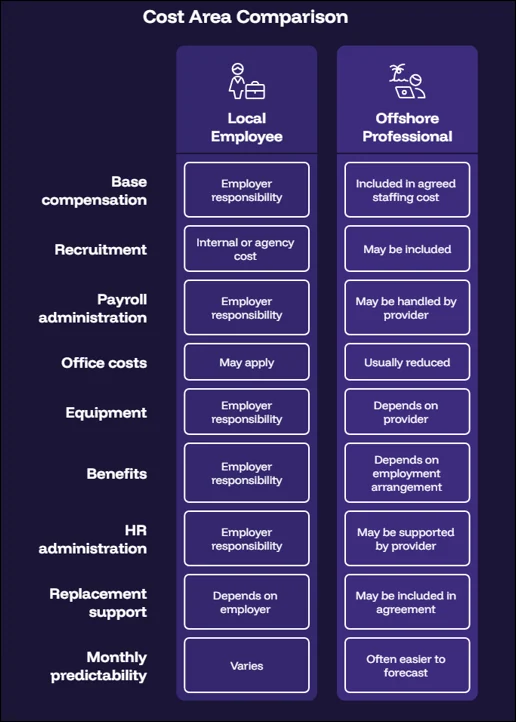
The important point is not that offshore staffing always costs a specific percentage less. The important point is that businesses should compare the complete cost of each model rather than comparing a salary with a staffing fee.
What Are the Benefits of Offshore Staffing?
1. Access to a Larger Talent Pool
Offshore staffing expands the geographical area from which you can recruit.
Instead of limiting hiring to one city or country, businesses can access professionals in international talent markets.
2. Potential Cost Reduction
Labor costs vary significantly between markets.
When structured correctly, offshore staffing can reduce the overall cost of building a team.
However, cost should not be the only selection criterion.
A low-cost professional who requires significant supervision or frequently leaves can create higher total costs over time.
3. Faster Team Expansion
Building a local team can take time, particularly for specialized positions.
A staffing partner with an established talent network can potentially shorten the sourcing and recruitment process.
4. Access to Specialized Skills
Offshore staffing can help companies access professionals with skills that may be difficult to find locally.
This is particularly relevant for areas such as:
- Software development
- AI and machine learning
- QA and testing
- Digital marketing
- Design
- Data services
- Customer support
- Finance
- Administrative support
5. Flexible Team Scaling
Businesses can add professionals based on workload and business requirements.
This can be useful for growing companies, seasonal workloads, new projects, and businesses entering new markets.
6. Extended Working Hours
Depending on the location and schedule, offshore teams can provide additional working-hour coverage.
This can help businesses support customers, continue development, or complete operational work outside the local team's normal working hours.
7. Focus on Core Business Activities
Delegating repeatable or specialized work to an offshore professional can free internal employees to focus on higher-value activities.
What Are the Risks of Offshore Staffing?
Offshore staffing has benefits, but it also comes with risks that businesses should evaluate before hiring.
1. Communication Gaps
Differences in communication styles, documentation practices, or expectations can create misunderstandings.
Solution: Establish clear communication channels, documentation standards, meeting schedules, and escalation procedures.
2. Time-Zone Differences
Time-zone differences can become a problem when the role requires constant real-time collaboration.
Solution: Define required working hours and overlap before hiring.
3. Data Security
Remote professionals may need access to customer data, internal systems, source code, financial information, or business applications.
Solution: Use individual accounts, MFA, least-privilege access, approved devices, appropriate monitoring, and clear offboarding procedures.
NIST's guidance on enterprise telework, remote access, and BYOD discusses security considerations for remote-access technologies and both organization-issued and BYOD devices.
4. Quality Issues
A poor screening process can result in candidates who do not have the skills required for the role.
Solution: Use structured screening and allow the client to interview shortlisted candidates.
5. Employee Turnover
Attrition can affect productivity and increase recruitment and onboarding costs.
Solution:Evaluate the provider's recruitment process, employee support, retention practices, and replacement policy.
6. Compliance and Employment Requirements
Cross-border employment can involve local labor laws, payroll requirements, tax considerations, contracts, and other obligations.
Solution: Understand who is responsible for employment administration and compliance before signing an agreement. For specific legal or tax questions, consult an appropriately qualified professional.
7. Management Challenges
An offshore employee still requires clear direction, onboarding, feedback, and performance management.
Solution: Treat offshore professionals as part of the team and establish measurable responsibilities and KPIs.
How to Build a Successful Offshore Team
Hiring the right person is only the beginning.
Define Clear Responsibilities
Create a detailed job description that explains:
- Responsibilities
- Required skills
- Experience
- Working hours
- Reporting structure
- KPIs
- Tools
- Expected outcomes
Establish Communication Rules
Decide:
- Which communication platform to use
- When meetings take place
- How quickly messages should be answered
- Where documentation is stored
- How urgent issues are escalated
Use Clear KPIs
Don't evaluate an offshore professional only by hours worked.
Measure outcomes relevant to the role.
Developer
- Sprint completion
- Code quality
- Bug resolution
- Delivery timelines
Digital Marketer
- Qualified traffic
- Content production
- Conversion metrics
- Campaign performance
Customer Support
- Response time
- Resolution rate
- Customer satisfaction
Provide Proper Onboarding
Give the employee access to:
- Company information
- Processes
- Tools
- Documentation
- Team communication channels
- Role-specific training
A structured onboarding process can reduce the time required for a new employee to become productive.
How to Keep Offshore Teams Secure
Security should be designed into the offshore staffing model from the beginning.
Before providing access:
- Create individual accounts
- Enable MFA
- Apply least-privilege access
- Use approved devices
- Define data-handling rules
- Provide security awareness training
- Establish incident-reporting procedures
- Review access periodically
- Remove access promptly when roles change or employment ends
A VPN can be useful for certain remote-access requirements, but it should not be treated as the only security control.
For sensitive environments, businesses should define security requirements based on their data, systems, regulatory obligations, and risk profile.
NIST's Guide to Enterprise Telework, Remote Access, and BYOD Security provides additional guidance for organizations designing and securing remote-access environments.
What Should You Look for in an Offshore Staffing Partner?
Choosing the provider can have a major impact on the success of the engagement.
Before signing a contract, evaluate:
Talent Sourcing
Ask how candidates are sourced and how the provider maintains its talent pool.
Screening
Understand whether candidates undergo:
- Technical screening
- Communication assessment
- Experience verification
- Reference checks
- Background checks where appropriate
Hiring Models
Confirm whether the provider offers:
- Full-time staffing
- Part-time staffing
- Direct sourcing
- Managed staffing
- EOR support
Employment Structure
Understand who employs the professional and who handles:
- Payroll
- Benefits
- Leave
- Employment documentation
- Local HR administration
Replacement Policy
Ask what happens if the professional resigns, becomes unavailable, or does not meet expectations.
Security
Ask about:
- Device policies
- MFA
- Access management
- Data handling
- Security training
- Incident reporting
- Offboarding
Communication
Understand how communication works between your company, the professional, and the staffing provider.
Pricing Transparency
Ask exactly what is included in the quoted price.
Do not evaluate providers only by their lowest monthly rate.
15 Questions to Ask an Offshore Staffing Company
Before choosing a provider, ask:
- How do you source candidates?
- How do you screen candidates?
- Can we interview and select the final candidate?
- Are professionals dedicated to our business?
- What full-time and part-time models do you offer?
- Who handles payroll and employment administration?
- What happens if a professional leaves?
- Is there a replacement policy?
- What security controls are used?
- How are company devices handled?
- How is access removed when someone leaves?
- What working hours and time-zone options are available?
- What management support is included?
- What exactly is included in the monthly cost?
- Are there additional recruitment, setup, technology, or administrative fees?
The answers should be clear before you commit to an offshore staffing arrangement.
When Is Offshore Staffing a Good Fit?
Offshore staffing can be a good option when your business:
- Needs additional team capacity
- Has difficulty finding local talent
- Wants to control hiring costs
- Needs specialized skills
- Has repeatable and measurable work
- Can manage remote employees effectively
- Wants to scale gradually
- Needs additional working-hour coverage
It may be less suitable when a role requires:
- Regular physical presence
- Frequent local travel
- Location-specific licensing
- Highly sensitive local relationships
- Constant face-to-face collaboration
- Access that cannot reasonably be provided remotely
The right decision depends on the role rather than simply the company's preference for offshore or local hiring.
Offshore Staffing Best Practices for 2027
As global hiring and remote work continue to evolve, businesses should focus on building structured offshore teams rather than simply hiring lower-cost resources.
- Hire for outcomes, not just job titles. Define what success looks like before hiring.
- Treat offshore professionals as team members. Give them clear responsibilities, communication access, documentation, feedback, and opportunities to contribute.
- Prioritize security from day one. Security should be part of onboarding rather than something added after the employee starts working.
- Use technology to improve collaboration. Use project management, communication, documentation, time tracking where appropriate, and collaboration tools that fit your workflow.
- Measure performance. Use role-specific KPIs rather than relying only on activity or hours.
- Build knowledge-sharing systems. Document processes so that important knowledge does not remain with one person.
- Plan for continuity. Have a documented process for employee absence, turnover, role changes, and replacement.
- Review the team regularly. Evaluate performance, workload, communication, skills, and business requirements.
- Avoid choosing solely on price. The cheapest option is not necessarily the lowest-cost option over the full lifecycle of the engagement.
- Start with a clearly defined role. A well-defined first role can make it easier to evaluate the model before expanding the team.
Offshore Staffing Checklist
Before hiring an offshore professional, confirm:
Role
- Responsibilities are clearly defined
- Required skills are documented
- Experience requirements are established
- KPIs are defined
- Working hours are agreed
Hiring
- Candidate screening process reviewed
- Final candidate interviewed
- Employment arrangement understood
- Pricing confirmed
- Replacement terms reviewed
Operations
- Communication tools selected
- Reporting structure established
- Onboarding plan created
- Documentation provided
- Performance review process established
Security
- Individual account created
- MFA enabled
- Least-privilege access applied
- Approved device confirmed
- Data-handling requirements communicated
- Offboarding process documented
Build Your Offshore Team With EVE
If you're considering offshore staffing, Elite Virtual Employee can help you explore dedicated remote staffing options across technology, digital marketing, and business support functions.
If you need a more proactive talent search, EVE's Direct Sourcing service can help identify, screen, and shortlist professionals based on your hiring requirements.
For ongoing roles, you can also explore EVE's Full-Time Hiring services.
Frequently Asked Questions
Final Thoughts
Offshore staffing in 2027 is not simply about finding people at a lower cost.
The strongest offshore staffing strategies focus on talent access, operational flexibility, scalability, security, and long-term team integration.
The right model can help businesses access specialized professionals, expand capacity, support growth, and build teams without being limited by local talent availability.
But success depends on how the model is structured.
Define the role clearly. Choose the right hiring model. Evaluate candidates carefully. Establish communication and performance expectations. Protect business data. Understand the employment arrangement. And choose a staffing partner that can support your requirements as the team grows.
Editorial Note: This article is intended for general informational purposes. Costs, employment requirements, tax obligations, and compliance considerations vary by country, role, and engagement structure. Businesses should obtain appropriate professional advice for specific legal, tax, employment, or regulatory requirements.