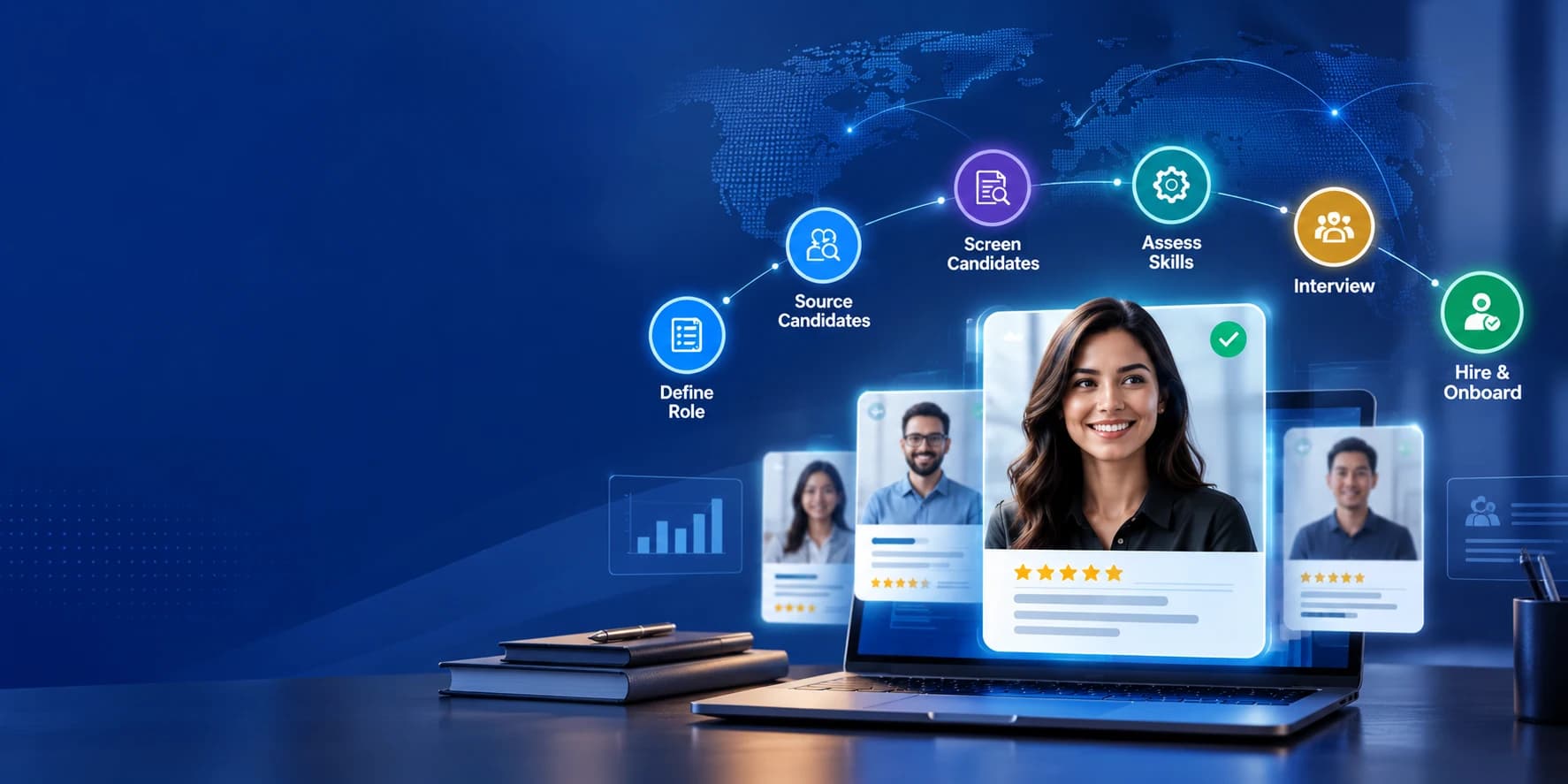
Hiring remote employees can give businesses access to a broader talent pool, specialized skills, and additional workforce capacity. But finding the right professional requires more than publishing a job description and reviewing resumes.
To hire remote employees without compromising quality, businesses should define the role clearly, identify the required skills, source suitable candidates, evaluate practical capabilities, conduct structured interviews, and establish a clear onboarding process.
A structured hiring process helps businesses evaluate candidates based on their actual ability to perform the role rather than relying only on resumes, job titles, or interview impressions.
This guide explains how businesses can build a practical remote employee hiring process from role definition through onboarding.
What Does Hiring Remote Employees Involve?
Hiring remote employees involves identifying a business requirement, defining the role, sourcing candidates, screening and evaluating their capabilities, conducting interviews, selecting the right professional, and preparing them to work effectively within the organization.
The fundamentals are similar to traditional hiring, but remote hiring requires additional consideration around communication, collaboration, working hours, technology, accountability, and remote-work expectations.
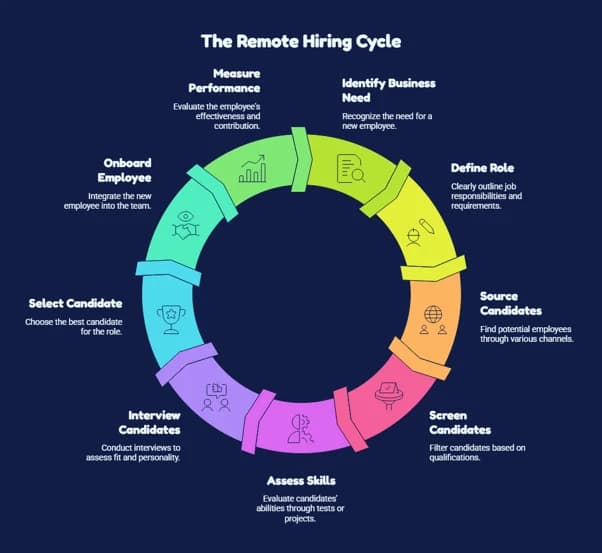
How to Hire Remote Employees: 12 Steps
Define the Role Before You Start Hiring
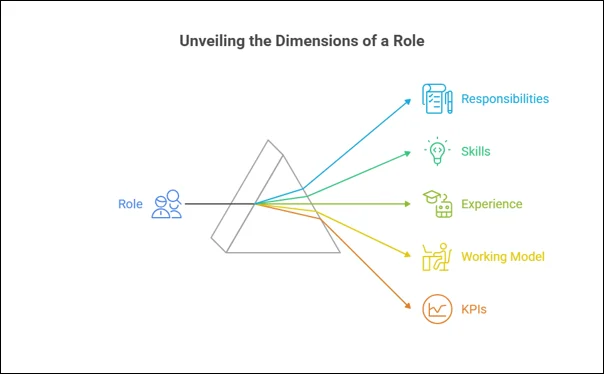
One of the most important parts of remote hiring is defining the position before searching for candidates.
A vague job description can attract many applicants without helping you identify the right professional.
Start by defining:
- Job title
- Primary responsibilities
- Required technical or functional skills
- Relevant experience
- Industry knowledge, if required
- Communication requirements
- Working hours or time-zone requirements
- Reporting structure
- Expected deliverables
- Performance indicators
For example, instead of simply searching for a "developer," determine whether the business needs a frontend developer, backend developer, full-stack developer, mobile developer, or another specific role.
The clearer the requirement, the easier it becomes to source and evaluate suitable candidates.
Determine What Type of Remote Employee You Need
Not every remote position requires the same workforce arrangement.
Before sourcing candidates, determine what the business actually needs.
Possible requirements include:
- Full-time remote employee
- Part-time professional
- Dedicated specialist
- Remote team member
- Professional supporting a specific business function
The decision should be based on workload, responsibilities, expected duration, management requirements, and the amount of capacity required.
The important point is to define the work requirement first and then determine the appropriate hiring arrangement.
Create a Clear Remote Job Description
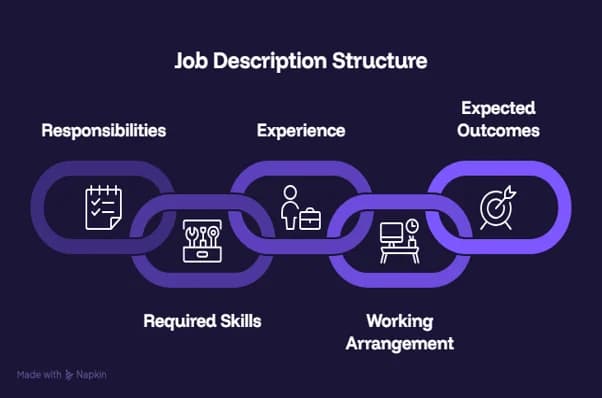
A remote job description should explain both the role and the working expectations.
Include:
Responsibilities
Explain what the employee will be expected to do.
Required Skills
Identify the technical, functional, and interpersonal skills needed.
Experience
Specify the type and level of experience relevant to the role.
Working Arrangement
Clearly communicate whether the role is full-time or part-time and whether specific working-hour or time-zone overlap is required.
Performance Expectations
Where possible, describe the outcomes or deliverables expected from the position.
A clear job description helps candidates understand the opportunity and gives the hiring team a consistent basis for evaluation.
Source Remote Candidates
Once the role is clearly defined, businesses can begin sourcing candidates.
Potential sourcing channels include:
- Professional networking platforms
- Online job boards
- Employee referrals
- Specialized talent networks
- Direct sourcing
- Recruitment providers
- Remote staffing providers
The right sourcing channel depends on the role, required skills, hiring volume, and available internal resources.
For specialized positions, businesses may need to use targeted sourcing rather than relying only on general job boards.
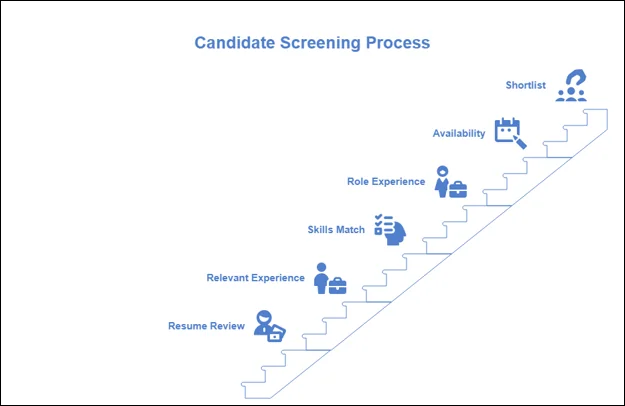
Screen Candidates Against the Actual Requirements
Receiving resumes is only the beginning.
Candidate screening should compare each professional against the requirements defined for the specific role.
Review areas such as:
- Relevant experience
- Technical or functional skills
- Previous responsibilities
- Industry experience
- Career progression
- Communication ability
- Availability
- Working-hour compatibility
- Remote-work experience, where relevant
Avoid relying only on job titles.
Two professionals with the same job title can have very different responsibilities, experience levels, and practical capabilities.
Use Role-Specific Assessments
Practical assessments can help businesses understand whether a candidate can apply their skills to the actual requirements of the role.
The assessment should be relevant to the position.
| Role | Example Assessment |
|---|---|
| Developer | Coding or technical exercise |
| Designer | Relevant design task |
| SEO Specialist | Website or search analysis |
| Content Writer | Writing assignment |
| Accountant | Financial scenario |
| Customer Support | Sample customer response |
The purpose is not to create unnecessary testing.
A good assessment should provide useful evidence about the candidate's ability to perform the work.
Conduct Structured Remote Interviews
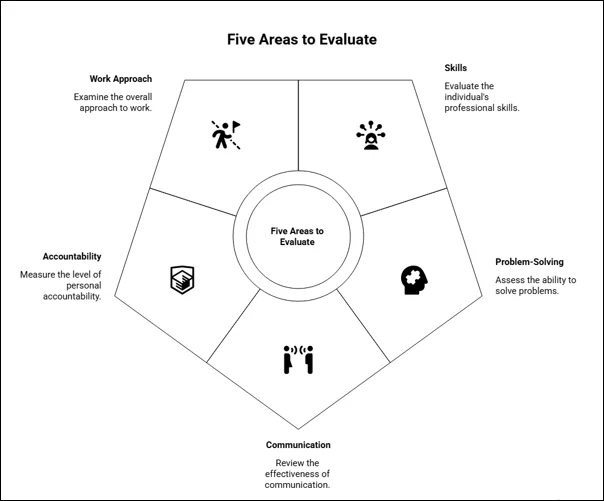
Remote interviews should evaluate more than technical qualifications.
A structured interview can cover:
Technical or Functional Capability
Can the candidate perform the core responsibilities?
Problem-Solving
How does the candidate approach unfamiliar or difficult situations?
Communication
Can the candidate communicate clearly through digital channels?
Accountability
How does the candidate manage responsibilities and deadlines?
Work Approach
Can the candidate work effectively within the company's processes?
Using consistent core questions for candidates applying for the same role can make the evaluation process more structured.
Evaluate Remote-Work Readiness
Remote employees often need to operate with a certain level of independence.
During the hiring process, consider whether the candidate can:
- Communicate proactively
- Manage assigned responsibilities
- Meet deadlines
- Work with digital collaboration tools
- Ask for clarification when necessary
- Document work clearly
- Participate effectively in virtual meetings
- Maintain reliable communication
Remote-work readiness should always be evaluated in the context of the actual role.
A highly collaborative position may require different communication capabilities from a role involving mostly independent work.
Complete Relevant Verification
For positions where references or background verification are appropriate, complete the necessary checks before finalizing the hiring decision.
Depending on the role and applicable requirements, this may include:
- Employment verification
- Reference checks
- Qualification verification
- Identity verification
- Other appropriate checks
The exact checks should depend on the role, location, business requirements, and applicable rules.
Clearly Define the Working Arrangement
Before the employee starts, both sides should understand how the remote working relationship will operate.
Clarify:
- Working hours
- Time-zone expectations
- Reporting manager
- Communication channels
- Meeting schedules
- Availability procedures
- Required tools
- Performance expectations
- Data and system access
- Security responsibilities
Clear expectations can reduce confusion after onboarding.
Prepare a Structured Remote Onboarding Process
Hiring does not end when the candidate accepts the offer.
Effective remote onboarding gives the new employee the information, access, tools, responsibilities, and support needed to begin contributing effectively.
A practical onboarding process can include:
Before the Start Date
Prepare accounts, system access, documentation, and introductory information.
First Week
Introduce the employee to the team, manager, tools, processes, and immediate responsibilities.
First 30 Days
Set priorities and establish measurable expectations.
Ongoing
Provide feedback, answer questions, monitor performance, and adjust responsibilities when necessary.
Set Clear Performance Expectations
A remote employee should understand what successful performance looks like.
Depending on the role, KPIs may include:
- Completed projects
- Delivery timelines
- Quality metrics
- Customer satisfaction
- Leads generated
- Technical performance
- Task completion
- Response times
- Other role-specific outcomes
KPIs should be connected to the employee's actual responsibilities.
Avoid measuring activity simply because it is easy to track. Focus on meaningful outcomes.
Common Mistakes When Hiring Remote Employees
Several common mistakes can make remote hiring less effective.
Hiring From a Resume Alone
A resume shows experience but does not always demonstrate how effectively someone can perform the required work.
Using a Generic Job Description
Broad requirements can make it harder to attract and evaluate the right candidates.
Skipping Practical Evaluation
For many roles, practical assessments can provide useful evidence that interviews alone may not reveal.
Ignoring Communication Requirements
Remote employees need to communicate effectively through digital channels.
Hiring Without Clear KPIs
Without defined expectations, employees and managers may have different ideas about successful performance.
Treating Remote Hiring Exactly Like Office Hiring
Many hiring fundamentals are the same, but remote roles require additional consideration around communication, collaboration, technology, working hours, and accountability.
How Long Does It Take to Hire a Remote Employee?
The time required to hire a remote employee depends on the role, required skills, sourcing method, candidate availability, interview process, and decision-making speed.
A straightforward role with readily available talent may move through the process quickly, while specialized positions can require additional sourcing and evaluation.
Instead of setting an arbitrary hiring timeline, businesses should focus on having a clearly defined requirement and an efficient evaluation process.
How Much Does It Cost to Hire a Remote Employee?
The cost of hiring a remote employee varies based on the role, experience level, location, engagement model, compensation structure, technology requirements, and other employment or operational costs.
Businesses should evaluate the total cost of the workforce model rather than comparing salary alone.
Depending on the arrangement, additional considerations may include:
- Recruitment costs
- Compensation
- Technology and equipment
- Management time
- Payroll administration
- Compliance requirements
- Benefits
- Training and onboarding
- Infrastructure
The actual cost should therefore be evaluated against the requirements of the specific role.
Should You Hire Remote Employees Directly or Use a Staffing Provider?
Businesses can use different approaches to build remote teams.
Direct Hiring
The business manages sourcing, screening, interviewing, hiring, onboarding, and ongoing employment processes internally.
Staffing Support
A staffing provider can support parts of the talent sourcing and hiring process, depending on the engagement model.
Remote Staffing
A business can work with a remote staffing provider to access professionals for defined workforce requirements.
The appropriate approach depends on internal hiring capacity, hiring volume, role complexity, management requirements, and the desired level of support.
Remote Employee Hiring Checklist
Before making a hiring decision, confirm that you have:
- Defined the role
- Documented responsibilities
- Identified required skills
- Defined experience requirements
- Established working-hour expectations
- Created a clear job description
- Selected appropriate sourcing channels
- Screened candidates against requirements
- Conducted a relevant skills assessment
- Completed structured interviews
- Evaluated communication and remote-work readiness
- Completed relevant verification
- Defined compensation and working arrangements
- Prepared onboarding requirements
- Established KPIs
If all seven areas are covered, the business has a clearer foundation for making a hiring decision.
How Elite Virtual Employee Supports Remote Hiring
Elite Virtual Employee helps businesses connect with remote professionals across technical and non-technical functions.
Depending on the business requirement, professionals can be sourced across areas such as:
- Software development
- Web and mobile development
- QA and software testing
- Digital marketing
- SEO
- Content writing
- Cybersecurity
- Virtual assistance
- Customer support
- Finance and accounting
- Business operations
Businesses can define the role, skills, experience, and working requirements they need and explore staffing options aligned with those requirements.
For organizations that need support identifying suitable remote professionals, EVE can help structure the talent search around the required role and workforce requirements.
Looking to hire remote employees? Explore EVE's remote staffing solutions and discuss the roles and skills your business needs.
Frequently Asked Questions
Final Takeaway
Successful remote hiring starts with a clearly defined business requirement, not simply a search for available candidates.
Businesses should define the role, identify the required skills, choose suitable sourcing channels, evaluate candidates against consistent criteria, conduct structured interviews, and establish clear expectations before the employee starts.
The goal is not simply to hire someone who can work remotely.
The goal is to hire a professional who can perform the required role effectively within the company's processes, communication structure, and business objectives.
A structured hiring process makes remote hiring more consistent, measurable, and repeatable as the organization grows.