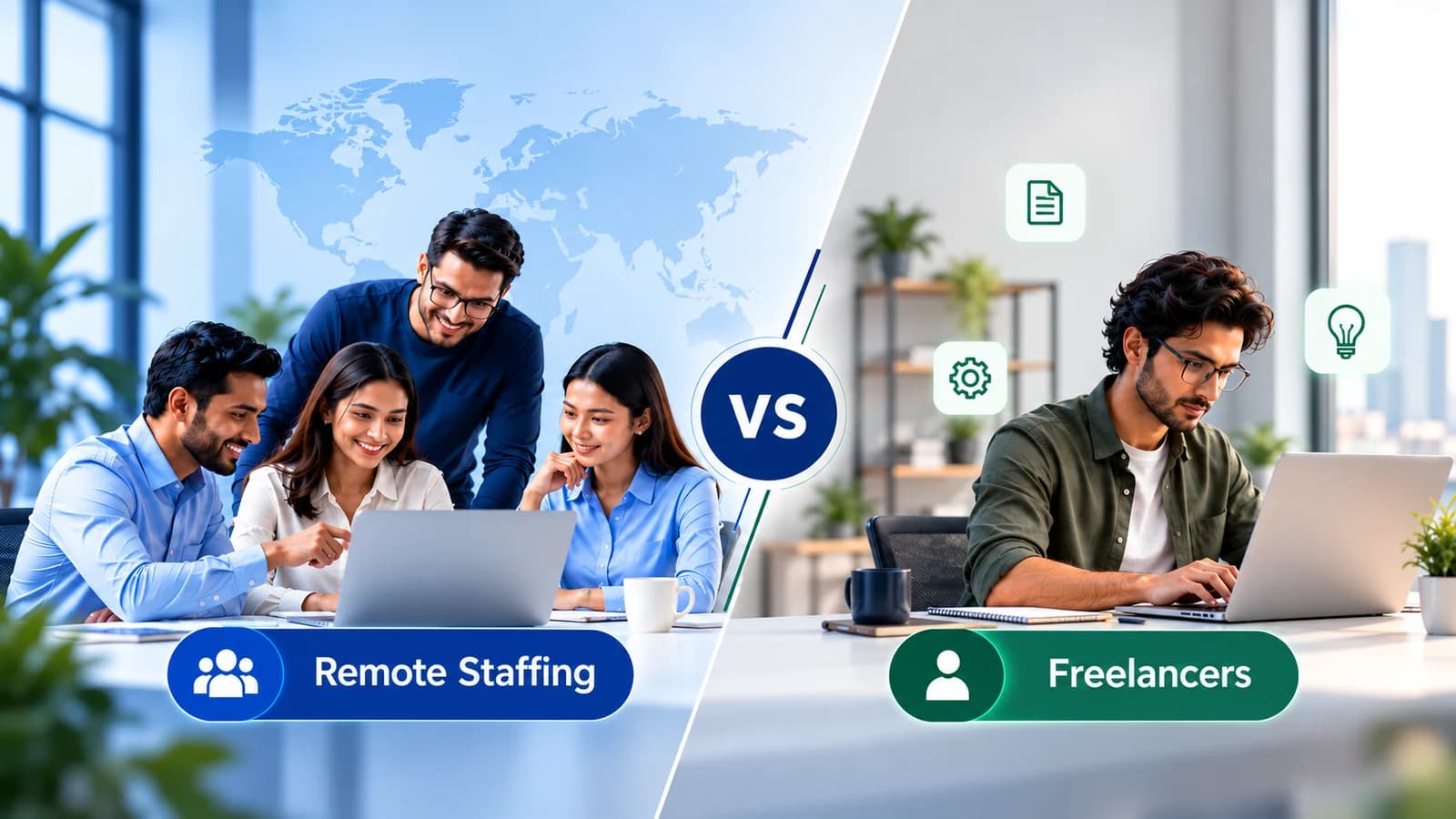
Businesses have more options than ever when it comes to accessing skilled talent. Instead of hiring every professional as an in-house employee, companies can work with freelancers, remote professionals, staffing providers, or a combination of these models.
But having more options can also make the decision more difficult.
If you are comparing remote staffing vs. freelancers, the important question is not simply which model is better. It is which model fits the type of work your business needs, how long you need the support, how closely the professional needs to work with your team, and how much continuity you require.
A freelancer can be a practical option for a defined project or specialized assignment. Remote staffing can be considered when a business needs ongoing capacity and recurring support.
Let's look at the differences and the factors businesses should consider before choosing.
Quick Answer: Remote Staffing vs Freelancers
Remote staffing may fit businesses that need ongoing support, recurring capacity, and consistent availability. Freelancers may be more suitable for defined projects, specialized assignments, or temporary workloads. The right choice depends on the role, duration, availability, collaboration requirements, and overall working arrangement.
Neither model is automatically right for every business. The nature of the work should guide the decision.
What Is Remote Staffing?
Remote staffing is a workforce model in which professionals work remotely while supporting a company's business requirements.
Depending on the staffing arrangement, businesses may access professionals in areas such as software development, quality assurance, digital marketing, SEO, content, design, customer support, finance, virtual assistance, cybersecurity, and other technical or non-technical functions.
The main consideration is continuity. Remote staffing can be structured around ongoing or recurring work, depending on the provider, role, and agreement.
For example, a business may need a software developer to work on its product continuously rather than hire someone only to complete one development task. Similarly, an organization may need ongoing SEO support instead of commissioning a single SEO project.
In situations like these, an ongoing staffing arrangement may be worth considering.
What Is Freelancing?
Freelancing generally involves working with an independent professional for a specific project, assignment, service, or defined period.
Freelancers can be useful when a company has a clearly defined requirement.
For example, a business might hire a freelancer to:
- Redesign a website
- Create a logo or visual assets
- Write a set of articles
- Complete a specific software development task
- Provide technical consulting
- Handle a temporary increase in workload
- Deliver a specialized project
The business gets access to a particular skill without necessarily creating an ongoing position around that work.
Remote Staffing vs Freelancers: What's the Difference?
The difference becomes clearer when you look at how the work will be performed.
| Factor | Remote Staffing | Freelancers |
|---|---|---|
| Typical use | Ongoing or recurring work | Defined projects or assignments |
| Availability | Can be structured around dedicated or recurring capacity | Depends on the freelancer and agreement |
| Continuity | Useful when ongoing knowledge matters | Can vary between projects |
| Collaboration | Can support ongoing team collaboration | Depends on project requirements |
| Management | Can involve regular workflows and supervision | Often centered around agreed deliverables |
| Scaling | Can support additional staffing needs | May require additional freelancers |
| Specialized work | Possible depending on available talent | Often suitable for specialized projects |
| Long-term requirements | Can be considered | Depends on the arrangement |
| Short-term requirements | Possible | Often suitable |
This is a general comparison. Actual responsibilities, availability, costs, and legal arrangements depend on the specific engagement.
Which Model Fits Your Type of Work?
One of the easiest ways to choose between remote staffing and freelancing is to look at the work itself.
For One-Time Projects, Freelancers May Make Sense
Imagine that your company needs a website redesign.
You already have an internal marketing and development team, but you need a specialist to handle the redesign. Once the project is completed, you may not need that particular skill again.
A freelancer may be suitable in this situation because the requirement has a defined scope and expected outcome.
The same could apply to a one-time content project, a specialized design assignment, or a technical consultation.
For Ongoing Responsibilities, Remote Staffing May Be Worth Considering
Now consider a different situation.
Your company needs someone to manage SEO every month. The work includes keyword research, technical SEO, content optimisation, reporting, internal linking, and ongoing improvements.
This is not a single project. It is an ongoing responsibility.
The same applies to roles such as:
- Software development
- QA and testing
- Customer support
- Digital marketing
- Virtual assistance
- Finance and accounting
- Content operations
When the work continues over time, an ongoing remote staffing arrangement may provide a structure that better matches the requirement.
Six Questions to Ask Before Choosing
There is no need to make the decision based only on the job title. Ask a few practical questions first.
1. Is the work temporary or ongoing?
A project with a clear completion date may fit freelance support.
A responsibility that continues month after month may require a different arrangement.
2. How much availability do you need?
If you only need someone for a few hours or specific deliverables, freelance support may be enough.
If you need recurring or dedicated capacity, consider whether the engagement can provide the availability your business requires.
3. How important is continuity?
Some roles become more valuable as the professional learns about your business.
An SEO professional, developer, customer support specialist, or finance professional may gradually become familiar with your systems, processes, customers, and internal workflows.
If replacing that knowledge would create disruption, continuity should be part of your decision.
4. How closely will the person work with your team?
A freelancer completing a defined deliverable may not need to participate in your daily workflow.
Other roles may require regular meetings, task management, feedback, documentation, and collaboration.
Think about how integrated the professional needs to be with your existing team.
5. How much management will be required?
Every external professional requires some level of coordination, but the amount can vary significantly.
A defined project may require a brief, milestones, and final delivery.
An ongoing role may require regular task assignment, meetings, training, feedback, reporting, and performance management.
Consider the internal time your business will need to invest.
6. Could your requirement grow?
Your initial requirement may be small.
For example, you may start by looking for one developer but later need QA, UI/UX, or additional development support.
Or you may start with SEO and later require content marketing, paid advertising, or analytics support.
If you expect the requirement to expand, consider whether your chosen model can accommodate additional capacity.
What About Cost?
Cost is often one of the first things businesses consider when comparing freelancers and remote staffing.
However, comparing only the quoted fee can give you an incomplete picture.
Consider the total cost of the arrangement, including:
- Professional or staffing fees
- Sourcing and hiring effort
- Onboarding
- Training
- Management time
- Software and tools
- Communication
- Rework
- Replacement or transition costs
- Administrative responsibilities
For example, a freelancer may have a lower project fee, but the business may need to spend significant internal time managing the project.
Similarly, a remote staffing arrangement should not be evaluated only by a monthly cost. Consider what is included in the arrangement, how much capacity you need, and what responsibilities the business will retain.
The right comparison is the total cost of getting the work done, not simply the headline price.
Don't Overlook Security
Remote professionals may need access to company applications, documents, customer information, communication platforms, or other business systems.
That makes security an important consideration regardless of whether you work with a freelancer or a remote staffing provider.
Businesses should think about:
- User authentication
- Access permissions
- Device security
- Data protection
- Secure remote access
- Password management
- Confidential information
- Access removal when work ends
- Personal device policies
The National Institute of Standards and Technology (NIST) provides guidance on enterprise telework, remote access, and bring-your-own-device security. Businesses can review NIST's guidance on telework, remote access, and BYOD security when developing appropriate security practices.
The specific security controls required will depend on the type of information, systems, and access involved.
Worker Classification Can Also Matter
Another consideration is how the professional is legally classified.
Using terms such as "freelancer" or "contractor" does not by itself determine a worker's legal classification.
For U.S. businesses, the IRS explains that classification depends on the facts of the working relationship. Its 2026 Publication 15-A discusses factors related to behavioural control, financial control, and the relationship between the parties.
You can review IRS Publication 15-A for 2026 for additional information.
Businesses operating in other countries should review the employment and contractor requirements that apply to their particular jurisdiction.
Do You Have to Choose Just One?
Not necessarily.
Some businesses use a combination of remote staffing and freelancers.
For example, a company may have ongoing remote professionals supporting software development and customer operations while bringing in a freelancer for a specialized design project.
Another business might maintain a remote marketing team while using a specialist consultant for a specific technical assignment.
A hybrid approach can therefore be useful when your business has both recurring and project-based requirements.
How to Decide Which Model You Need
A simple way to think about the decision is:
Consider freelance support if:
- You have a defined project
- The deliverables are clear
- The requirement is temporary
- You need specialized expertise
- Ongoing availability is not essential
Consider remote staffing if:
- The work is ongoing
- You need recurring capacity
- Consistent availability is important
- The professional needs to understand your business over time
- Collaboration with your internal team is important
- The requirement may expand
Consider a combination if:
- Some work is ongoing
- Some work is project-based
- You occasionally need specialized expertise
- Your workload changes throughout the year
What Should You Define Before Hiring?
Whichever model you choose, a clear requirement can make the hiring process easier.
Before contacting a freelancer or staffing provider, define:
- The role or project
- Main responsibilities
- Required skills
- Experience requirements
- Expected availability
- Duration
- Reporting structure
- Communication expectations
- Tools and systems involved
- Security requirements
- Expected outcomes
- Start date
The clearer the requirement, the easier it becomes to find an arrangement that matches your business.
How Elite Virtual Employee Supports Remote Staffing
Businesses looking for ongoing remote professionals can also explore staffing providers as an alternative to sourcing every professional independently.
Elite Virtual Employee provides remote staffing support across technical and non-technical functions, including software development, QA and testing, digital marketing, SEO, content, design, finance, customer support, virtual assistance, and other business functions.
If you need help identifying professionals for a specific requirement, EVE's Direct Sourcing service provides a structured approach to sourcing candidates based on your hiring requirements.
For businesses looking for an ongoing position, EVE also offers full-time hiring options based on the role, skills, and capacity required.
The right model ultimately depends on your work, workforce requirements, and preferred engagement structure.
Frequently Asked Questions
Conclusion
Choosing between remote staffing and freelancers starts with understanding your business requirements. Consider the duration of the work, the skills required, the level of ongoing support, and your expected workload.
For defined projects, freelance support may be suitable. For recurring responsibilities, remote staffing may be worth considering. If your business needs both, a combination can offer greater flexibility.