Remote hiring can give businesses access to a wider talent pool, specialized skills, and more flexible workforce options. But remote hiring also creates easy-to-overlook challenges, especially when a company focuses on filling a position quickly rather than building the right hiring process.
The biggest remote hiring mistakes usually happen before the candidate even joins. An unclear job description, weak screening process, poor communication expectations, or overlooked compliance requirements can create problems that become expensive to fix later.
Whether you are hiring one remote professional or building a distributed team, a structured remote staffing approach can help you define requirements, evaluate candidates, and establish expectations before the hiring decision is made.
This guide explains the most common remote hiring mistakes, why they happen, and what businesses can do differently to build reliable remote teams.
What Are the Most Common Remote Hiring Mistakes?
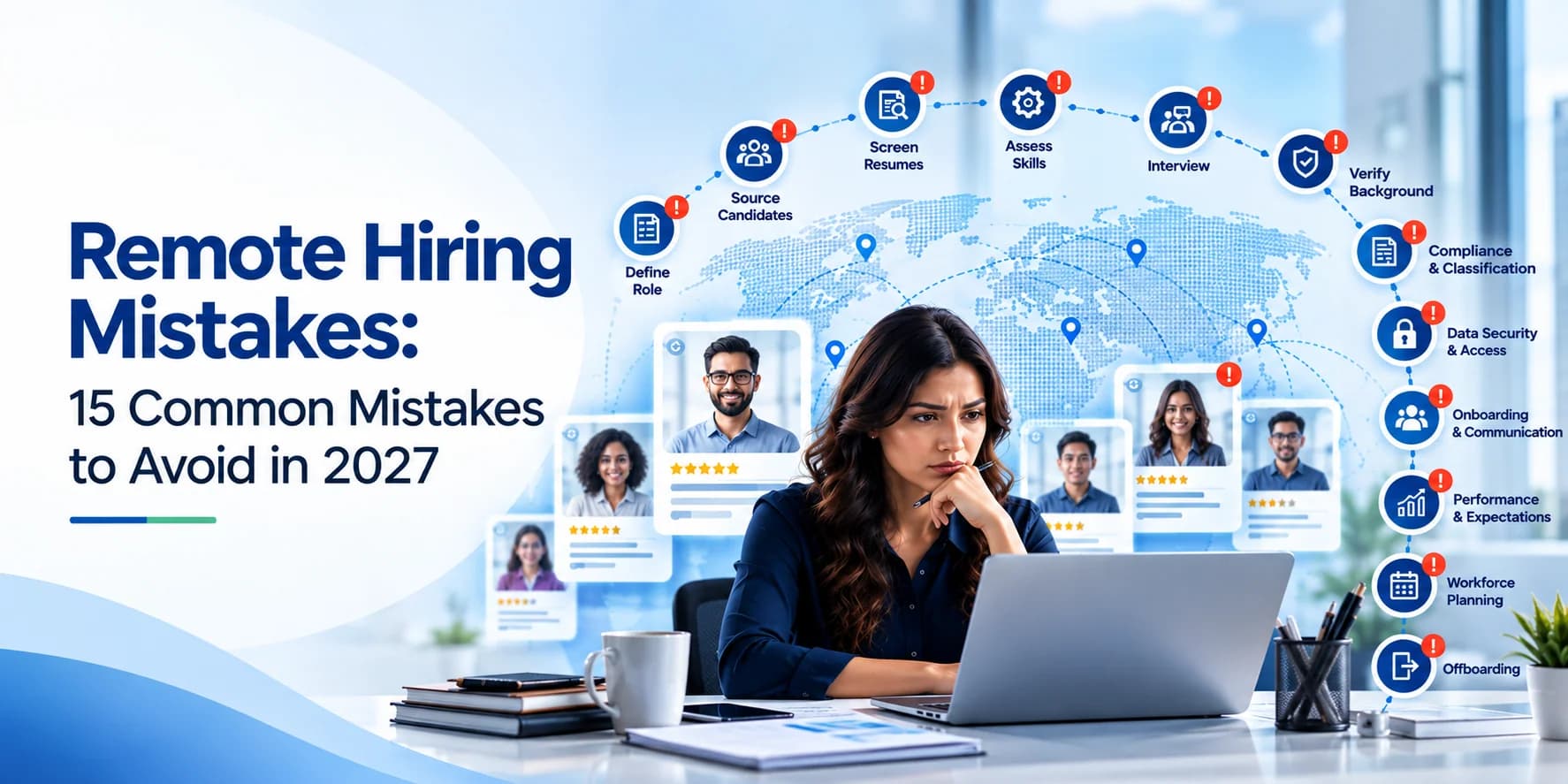
The most common mistakes include hiring without clearly defining the role, choosing candidates primarily because they are cheaper, relying too heavily on resumes, skipping practical assessments, overlooking communication and time-zone requirements, using inconsistent interviews, ignoring verification and compliance, and failing to prepare for onboarding, performance management, and offboarding.
The important point is that remote hiring is not simply traditional hiring conducted over a video call. The hiring process needs to account for how people communicate, collaborate, access company systems, manage their work, and operate within the organization's processes.
1. Hiring Before Clearly Defining the Role
One of the most common remote hiring mistakes is starting recruitment before the business has clearly defined what the person will actually be responsible for.
A job title such as "Remote Marketing Specialist" can mean very different things from one company to another. One business may need someone focused on SEO and content, while another may expect the same person to manage paid advertising, social media, analytics, and lead generation.
When the role is unclear, the problem spreads throughout the hiring process. Candidates may misunderstand the position, recruiters may shortlist unsuitable profiles, and interviewers may evaluate people against different expectations.
Before opening the position, define the responsibilities, required skills, reporting structure, working hours, communication expectations, and expected outcomes.
A good remote job description should help a qualified candidate understand not only what they will do, but also how success will be measured.
2. Choosing the Cheapest Candidate Instead of the Right Candidate
Cost is naturally an important consideration when hiring remote professionals. However, making the lowest salary or hourly rate the primary selection criterion can create problems later.
A candidate who costs less but needs extensive supervision, produces inconsistent work, or lacks an important skill may ultimately cost more in management time, delays, rework, and replacement hiring.
The better question is not simply, "Who is the cheapest candidate?"
It is:
"Which candidate can deliver the required results at a reasonable total cost?"
Consider experience, technical or functional capability, communication, reliability, expected productivity, management requirements, and the likely length of the engagement.
Remote hiring should be evaluated on overall value rather than compensation alone.
3. Relying Only on Resumes
A resume can tell you where someone worked, what technologies they have used, and how much experience they claim to have. It cannot, by itself, tell you how effectively they will perform in your specific environment.
This is particularly important for remote positions because independence and practical execution often matter as much as qualifications.
For example, a developer may list several programming languages but still struggle to work within your development process. A content writer may have years of experience but produce content that does not match your audience or brand voice.
Use the resume as a starting point, not the final decision-making tool.
Combine resume review with interviews, relevant assessments, portfolio or work-sample reviews, references where appropriate, and conversations about how the candidate approaches real work situations.
4. Skipping Practical Skills Assessments
Interviews are useful, but they do not always provide enough evidence of how a person will perform the actual job.
A practical assessment can make the evaluation much more relevant.
For a developer, that could mean reviewing or creating a small piece of code. For a content writer, it could involve writing a short article section. For a digital marketer, it might involve analyzing a campaign or identifying SEO opportunities. For a customer support role, it could involve responding to realistic customer scenarios.
The assessment should be directly related to the job and reasonable in scope. It should not become an unpaid project that requires several hours of work.
Selection procedures should also be designed carefully and consistently. In the U.S., the EEOC notes that employment tests and other selection procedures can raise discrimination concerns when they are not appropriately designed or used.
The goal is simple: test the capability you actually need.
5. Ignoring Communication and Remote-Work Readiness
Technical ability does not automatically translate into successful remote work.
A remote professional may have excellent technical skills but struggle if they cannot communicate clearly, provide updates, ask for clarification, document their work, or manage priorities independently.
This does not mean hiring people based on personality or expecting everyone to communicate in the same way. Instead, evaluate whether the candidate's working style fits the requirements of the role.
During interviews, ask practical questions such as:
- "How do you handle a task when the requirements are unclear?"
- "How do you communicate when you are blocked?"
- "How do you keep your manager informed about progress?"
- "How do you prioritize when several tasks become urgent?"
The answers can reveal much more about remote-work readiness than generic questions about strengths and weaknesses.
6. Ignoring Time Zones and Working Hours
Remote hiring can give businesses access to talent in different regions, but geographic flexibility does not eliminate scheduling requirements.
A candidate may be highly qualified but still be a poor fit if the role requires several hours of daily overlap with a team in another time zone and the candidate cannot reasonably work those hours.
This is particularly important for roles involving customer support, sales, meetings, development collaboration, or real-time project coordination.
Define the expected working schedule before recruitment begins. If complete time-zone overlap is unnecessary, identify the specific hours when collaboration is required.
This creates a better experience for both sides and prevents a common situation where expectations about availability only become clear after the person has joined.
7. Using an Unstructured Interview Process
Remote interviews can easily become inconsistent.
One interviewer may focus heavily on technical skills, another may concentrate on communication, while another may simply decide whether they "like" the candidate. When every candidate is evaluated differently, comparing them objectively becomes difficult.
A structured interview does not have to feel robotic.
The hiring team can prepare a consistent set of core questions while leaving room for natural conversation. Each interviewer should also understand which areas they are responsible for evaluating.
For example, one stage may focus on technical capability, another on role-specific problem solving, and another on communication and team collaboration.
The objective is not to make every interview identical. It is to make the evaluation criteria consistent.
8. Failing to Verify Candidate Information
Trust is important in any hiring relationship, but trust should not replace reasonable verification.
Depending on the position and applicable laws, verification may include employment history, qualifications, professional references, identity, or other information relevant to the role.
The exact process should depend on the position, location, engagement model, and legal requirements.
For example, a senior finance role handling sensitive financial information may require a different verification process from a short-term creative position.
The important principle is proportionality. Verify the information that matters for the role, use reliable sources, and handle candidate information responsibly.
A structured sourcing and screening process can also reduce the risk of relying solely on self-reported information. EVE's direct sourcing process, for example, includes candidate screening for skills, experience, communication, availability, and agreed verification requirements.
9. Overlooking Worker Classification and Employment Compliance
This is one of the areas businesses should take seriously when hiring across borders.
Calling someone a "contractor" does not automatically make them an independent contractor. Classification depends on the actual relationship and the applicable law.
For example, the U.S. Internal Revenue Service explains that worker classification depends on factors such as behavioral control, financial control, and the relationship between the parties. The IRS also specifically notes that working remotely does not by itself determine whether someone is an employee or an independent contractor.
International hiring can introduce additional considerations involving employment contracts, taxes, benefits, payroll, working hours, and local employment requirements.
Businesses should therefore establish the appropriate employment or engagement structure before the person begins working.
When the legal or tax position is unclear, obtain advice from an appropriately qualified professional rather than relying on assumptions.
10. Treating Data Security as an Afterthought
A remote employee may need access to company email, customer information, cloud applications, source code, financial systems, internal documents, or other sensitive resources.
Giving a new hire broad access simply because they need to "get started quickly" can create unnecessary security exposure.
Security should be considered before access is granted.
A better approach is to determine what systems the person actually needs, provide the minimum appropriate access, use strong authentication, establish device and password requirements, and remove access when it is no longer required.
For organizations with distributed teams, security should not depend solely on whether someone is working from an office or from home. NIST's Zero Trust guidance emphasizes that access should not be implicitly trusted simply because of a user's network or physical location.
Remote hiring therefore needs to connect with the company's broader identity, access, device, and data-security practices.
11. Failing to Define Performance Expectations
"Work hard and do your best" is not a performance framework.
Remote professionals need to understand what successful performance looks like. Without clear expectations, a manager may believe an employee is underperforming while the employee believes they are meeting the requirements.
The solution is to define measurable outcomes.
For some roles, this could mean completed development milestones. For sales, it could involve qualified opportunities or revenue-related targets. For content, it might involve publishing quality, production volume, organic performance, or other agreed objectives.
Not every role needs a long list of KPIs.
In many cases, three or four meaningful outcomes are more useful than fifteen metrics that nobody reviews.
Performance expectations should also be discussed during onboarding and revisited as responsibilities change.
12. Providing Poor Remote Onboarding
Hiring does not end when the candidate accepts the offer.
A new remote employee can struggle during the first few weeks if they do not know who to contact, which tools to use, where documents are stored, what meetings they should attend, or what they are expected to accomplish first.
Remote onboarding needs to compensate for the lack of informal office interactions.
A simple onboarding plan can make a significant difference. Introduce the employee to the team, provide system access, explain communication channels, share important documentation, clarify responsibilities, and establish the first set of priorities.
Most importantly, give the employee a clear understanding of what should happen during the first week, first month, and early performance-review period.
A well-structured onboarding process turns a new hire from someone who has access to company systems into someone who understands how to contribute.
13. Failing to Document Processes
Remote teams cannot rely on someone walking over to a colleague's desk to ask how something works.
When important processes exist only in someone's memory, knowledge becomes difficult to transfer.
This becomes particularly problematic when a team grows, responsibilities change, or an employee leaves.
Document recurring processes, important workflows, access procedures, project requirements, approval processes, and other information that someone else may need to perform the work.
Documentation does not need to become a massive internal manual.
A well-maintained knowledge base, project documentation, standard operating procedures, and clearly organized shared files can provide enough structure for most teams.
Good documentation also makes remote collaboration easier because employees can find answers without waiting for another person to become available.
14. Hiring for Today's Requirement Without Considering Tomorrow's Needs
A remote hire should solve a business problem, but companies should also consider how the role may evolve.
For example, a business may initially need one developer to support a specific project. Six months later, it may need additional development capacity, QA support, project management, or technical leadership.
If workforce planning happens only when a problem becomes urgent, every new hiring requirement can become a fire drill.
Before making the hire, consider whether the role is temporary or ongoing, whether responsibilities are likely to expand, and what skills the business may need as the team grows.
This does not mean hiring people for responsibilities they do not have today. It means building a workforce plan that can adapt as business requirements change.
For businesses looking for ongoing roles, a dedicated full-time hiring model may be more appropriate than repeatedly hiring for individual short-term tasks. EVE's full-time hiring approach, for example, focuses on defining requirements, sourcing candidates, screening them, and building dedicated roles around business needs.
15. Forgetting About Remote Offboarding
Offboarding is often ignored because the hiring team is focused on getting the person into the organization.
But remote offboarding deserves the same level of planning as onboarding.
When someone leaves, the business needs to think about system access, company equipment, credentials, documents, project ownership, customer information, and knowledge transfer.
Access should be removed promptly and responsibilities should be transferred clearly.
This is especially important when the employee had access to sensitive systems or customer information.
A good offboarding process also protects the business from losing important knowledge. Before the employee leaves, identify active projects, outstanding tasks, important contacts, recurring responsibilities, and documentation that another team member will need.
Remote workforce management should cover the full employee lifecycle, not just recruitment.
How to Avoid Remote Hiring Mistakes
Avoiding remote hiring mistakes does not require a complicated recruitment system. It requires a process that connects hiring decisions with the actual needs of the business.
Start by defining the role clearly. Decide what the person needs to accomplish, which skills are essential, and how the role will fit into the existing team.
Next, create a consistent evaluation process. Use resumes to understand a candidate's background, but combine them with interviews, relevant assessments, work samples, and appropriate verification.
Then establish the working model before the person joins. Clarify working hours, time-zone expectations, communication channels, reporting relationships, security requirements, and performance expectations.
Finally, think beyond recruitment. Onboarding, documentation, performance management, workforce planning, and offboarding are all part of building a reliable remote team.
The objective is not to create a perfect hiring process. It is to remove avoidable uncertainty before it becomes an expensive problem.
A Practical Remote Hiring Checklist
Before making a remote hiring decision, ask:
- Have we clearly defined the role and responsibilities?
- Do we know which skills are essential versus desirable?
- Have we defined the expected working hours and time-zone overlap?
- Are the interview criteria consistent for all candidates?
- Have we evaluated practical skills where appropriate?
- Have we verified important candidate information?
- Is the employment or engagement structure appropriate?
- Have we considered applicable tax, payroll, and employment requirements?
- Does the candidate understand how performance will be measured?
- Is onboarding ready before the person starts?
- Does the employee know which tools and systems they will use?
- Have we documented the processes they will need?
- Have we planned how the role could evolve?
- Is there a process for managing access and company information?
- Do we have an offboarding process?
If several of these questions have no clear answer, the hiring process probably needs more preparation before the position is filled.
Frequently Asked Questions
Conclusion
Remote hiring can be a practical way to access specialized talent and build flexible teams, but the quality of the outcome depends heavily on the hiring process.
The biggest problems usually do not come from remote work itself. They come from unclear roles, weak candidate evaluation, unrealistic expectations, poor communication, inadequate onboarding, and insufficient attention to compliance and security.
A stronger approach is to treat remote hiring as a complete workforce process rather than simply a way to fill vacancies.
Define the role before sourcing. Evaluate candidates against real requirements. Set expectations before the first day. Protect company information. Document important processes. And plan for the employee's entire lifecycle, including eventual offboarding.
When these fundamentals are in place, businesses can make remote hiring decisions with greater clarity and build teams that are better aligned with their long-term goals.
If your business is planning to build a dedicated remote team, Elite Virtual Employee can help you explore remote staffing, direct sourcing, and full-time hiring options based on your workforce requirements.