According to Gallup’ report, 67% of managers say they find it difficult to measure how well their remote workers are performing. Although there is nothing to suggest that remote workers are not as productive as their office-based counterparts (research has shown them to be just as productive), the issue with traditional performance measures is that they require visibility, presence and informal cues – something often lacking in remote work.
Time spent doesn’t always equal output. Being online doesn’t necessarily mean you’re working. Activity doesn’t always equal business outcomes. If your performance management system relies on any of these, then it is destined to fail for your remote team – and you won’t even know why.
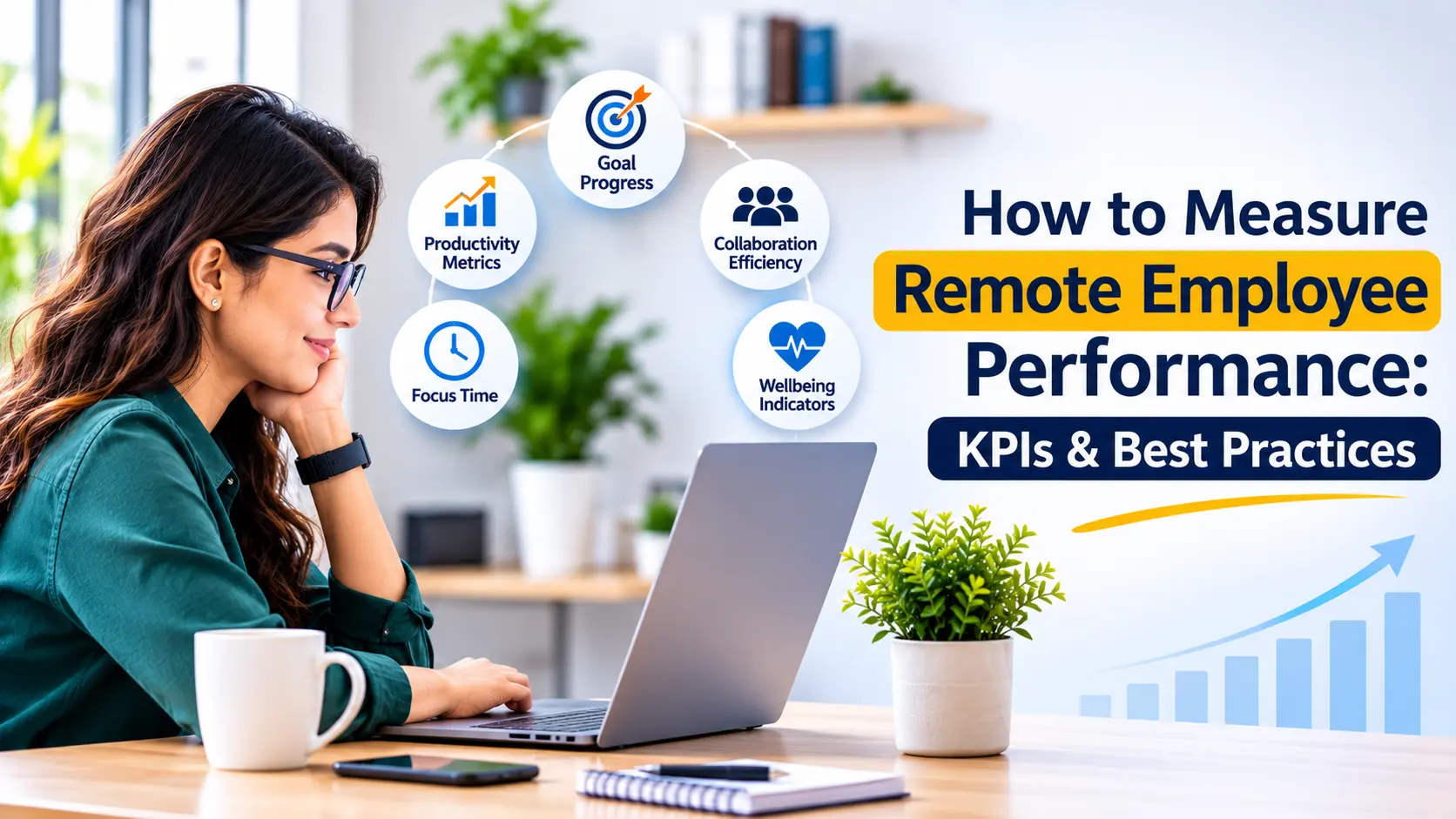
This blog post highlights a structured and data-driven approach to measuring the performance of your remote employees using key factors such as focus, collaboration, progression and wellbeing. No micromanaging or monitoring required.
Why Traditional Performance Metrics Fail Remotely
Traditional methods of performance management were created with a co-located working environment. When working in an office, managers will have a number of informal indicators to determine how well their team are performing. They’ll know who is arriving early, staying late, working well with others and appearing to be overworked. While this is not perfect, it provides some visibility.
Working remotely takes away all of these indicators. Only leaving the organisation with formal indicators which for most organisations aren’t good enough.
In remote environments, those who contribute the most in meetings, send the most messages and respond the quickest will gain visibility. However, those who are trying to optimise their visibility are often not doing deep work. An engineer taking 4 hours to mute Slack and solve a complex architecture issue is contributing more than someone who responds to all messages in less than 2 minutes. However, the traditional indicators would reward the latter.
Those organisations truly measuring performance in a remote environment are measuring outcomes. They are focusing on quality, collaboration, goals and wellbeing. These are the 5 pillars of performance management in a remote environment.
The 5 Pillars of Remote Performance Measurement
Outcome Metrics
Outcome metrics are the essential standards for every organisation as they define what’s really important for the business.
For each role, define 3-5 outcome metrics that directly connect individual work to business value:
Deliverables completed: Features shipped, reports delivered, campaigns launched, deals closed
Quality scores: Bug rates, revision rates, customer satisfaction, error frequency
Milestone adherence: Percentage of deadlines met, sprint commitments delivered
Business impact: Revenue influenced, costs reduced, efficiency improved
Focus Time Analytics
Focus time (uninterrupted blocks of deep work) is the prime indicator of knowledge worker productivity. Research from McKinsey, proves workers need more than 4 hours of daily focused, uninterrupted work to produce their best output.
Key focus time metrics are:
Daily focus hours: Target 4+ hours per day for deep work roles
Fragmentation score: How often focus blocks are interrupted by meetings and notifications
Focus time trend: Is focus time improving or declining week over week?
Focus time distribution: Are some team members getting significantly less focus time than others?
Collaboration Efficiency
Remote work does not always mean going solo. Most of the work requires coordination, and the efficiency of that coordination directly impacts performance.
Measure collaboration efficiency through:
Meeting load ratio: Hours spent in meetings as a percentage of total work hours. Healthy range is 20-30% for most roles. Above 40% signals meeting overload.
Async vs. sync balance: Ratio of asynchronous communication (documented decisions, written updates) to synchronous communication (meetings, calls). Higher async ratios correlate with better remote team performance.
Response patterns: Average response time during work hours, response time variance, and after-hours response frequency. Fast responses during work hours with no after-hours responses indicate healthy boundaries.
Cross-team collaboration: Frequency and quality of interaction with other teams. Isolated team members often signal onboarding gaps or role ambiguity.
If you’re looking for a full guide for building a remote team, you can easily find that in our blog post on how to build a scalable remote team in 2027.
Goal Progress
Outcome metrics tell you what was delivered. Goal progress metrics tell you whether the right things are being delivered — and whether delivery is on track.
Effective remote performance measurement tracks:
OKR/KPI completion rate: Percentage of quarterly objectives on track, at risk, or behind
Sprint velocity: Story points or work units completed per sprint, with trend analysis
Project milestone velocity: Speed of progression through project milestones relative to plan
Priority alignment: Percentage of time spent on top-priority work vs. reactive or low-priority tasks
Wellbeing Indicators
The most overlooked dimension of remote performance measurement is employee wellbeing. Remote work blurs the boundary between work and personal life, and the most common failure mode is not underperformance — it is overperformance that leads to burnout.
Critical wellbeing indicators include:
After-hours work patterns: Frequency and duration of work activity outside normal working hours
Weekend activity: Any sustained weekend work is a burnout signal
Declining focus time: A gradual decline in focus time over 2-4 weeks often indicates early burnout
Meeting overload trends: Increasing meeting load without corresponding outcome improvements
Leave utilization: Employees who do not take time off are at higher burnout risk
Common Mistakes in Remote Performance Measurement
Mistake 1: Measure hours, not results
This is the most common mistake. If you measure hours then all you know is how long someone has sat at their computer. You will be rewarding people based on how much time they’ve spent at their desk, and your best workers who are efficient will be penalized. Your least productive workers will look like they’re doing well as they appear to be spending lots of time working.
Mistake 2: Using the data to fire your employees
If you’re using the monitoring data to build cases against your employees you’ll find they’ll start gaming the system. Focus on using the data to start conversations during 1:1s.
Mistake 3: Not paying attention to wellbeing
Burnout will kill your remote team. An employee that is working 12 hours a day and replying to messages at midnight might seem like your best worker, but once they leave with no notice or their work quality drops off a cliff. Make sure you are monitoring wellbeing metrics.
Mistake 4: Not letting employees see their data
If employees can see their productivity data, they’ll improve themselves. But if only Managers can see the data, employees will feel like they’re being spied on. The most impactful thing you can do to improve your remote performance metrics is to give everyone an individual dashboard.
Mistake 5: Using the same metrics for different roles
You will never be able to measure an engineer in the same way as a salesperson. An individual contributor shouldn’t have the same focus time goals as a manager. A junior employee shouldn’t have the same output goals as a senior. Customize your metrics based on their role, level and team.
Start Measuring What Matters
Performance management doesn’t have to be complex, nor do you need to resort to monitoring your team. Instead, by measuring your focus time, outcome focus, productivity, goal progress and well-being, you’ll create an accurate, fair and effective performance measurement system.
Companies with successful remote working models will not be the ones monitoring, but those who utilise the right measures to support, coach and encourage their teams.
Elite Virtual Employee (EVE) supports businesses to grow by providing skilled virtual professionals, technical solutions and managed business services. We offer IT services, digital marketing, virtual staffing and business support to enable companies to get the right expertise, streamline and achieve their business objectives.