
Virtual assistants can help businesses manage recurring tasks such as email and calendar management, customer support, data entry, research, marketing coordination, and sales administration. Depending on their skills, they can also support e-commerce operations, bookkeeping administration, and routine technical workflows.
The right tasks to delegate depend on your business needs, the assistant’s expertise, and the level of responsibility involved. This guide explains common virtual assistant tasks, provides practical examples, and shows you how to choose the right responsibilities to delegate.
At a Glance: Common Virtual Assistant Tasks
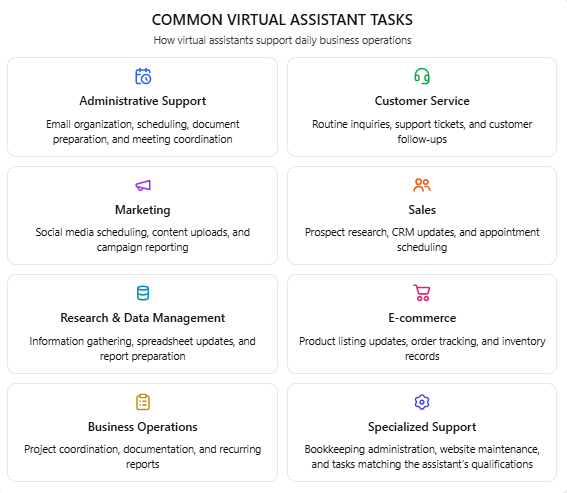
The best tasks to delegate are usually recurring, clearly defined, and easy to review. Tasks involving sensitive information, financial authority, or professional judgment require additional safeguards.
What Tasks Can a Virtual Assistant Do?
Virtual assistant responsibilities vary by role and experience. Some assistants focus on general administration, while others specialize in marketing, customer service, sales operations, or technical support. The following categories explain common responsibilities and how businesses can use them.
Administrative and Executive Support Tasks
Administrative support helps businesses manage daily coordination, communication, and documentation. These responsibilities are often a practical starting point because they can be organized into repeatable processes.
Organizing inboxes and flagging priority emails
Managing calendars and scheduling appointments
Preparing meeting agendas and taking notes
Coordinating travel arrangements and itineraries
Formatting documents and presentations
Maintaining digital files and records
Sending reminders and tracking follow-up actions
Updating project management tools
Coordinating routine communications
Example: A business owner can delegate calendar management and routine meeting coordination to spend less time arranging appointments and more time on business priorities.
For executive support, establish clear guidelines for confidential communications and identify which messages require personal approval.
Customer Service Tasks
A virtual assistant with relevant customer service experience can help manage routine inquiries and organize support requests across email, chat, phone, or other approved channels.
Answering routine customer questions
Responding using approved templates
Creating and updating support tickets
Checking order or service status
Recording customer feedback
Following up on unresolved requests
Maintaining frequently asked questions
Escalating complaints and complex issues
Example: An online business can delegate order-status inquiries while keeping unusual refund requests, disputes, and sensitive complaints with an authorized team member.
Provide response guidelines, escalation rules, and clear expectations for response times to maintain service quality.
Marketing and Social Media Tasks
Virtual assistants can support marketing execution by handling routine coordination and publishing activities. Strategy-intensive work should be assigned to someone with the relevant marketing expertise.
Scheduling approved social media posts
Maintaining content calendars
Uploading blog posts to a content management system
Formatting articles and adding approved images
Preparing email campaign drafts
Organizing marketing assets
Compiling campaign performance reports
Researching relevant industry topics
Maintaining campaign spreadsheets
Example: A marketing manager can develop the campaign strategy and approve messaging while a VA schedules posts, formats blog content, and organizes reporting data.
SEO strategy, paid advertising, conversion optimization, and advanced analytics may require a dedicated specialist. Assign these responsibilities according to demonstrated skills.
Sales and Lead Generation Tasks
Sales teams can delegate research and administrative work so representatives can focus on customer conversations and relationship building.
Researching companies that match a target customer profile
Compiling prospect information from permitted sources
Updating CRM records
Checking contact records for missing information
Scheduling sales meetings
Maintaining follow-up reminders
Preparing pipeline reports
Organizing sales presentations and documents
Recording lead status and next steps
Example: A sales manager defines the target audience and qualification criteria. The VA researches suitable companies, updates the CRM, and prepares information for the sales team.
Prospect research and outreach should follow applicable privacy, data protection, and electronic marketing requirements. Use approved messaging and contact lists.
Data Entry and Research Tasks
Data entry and research help businesses keep information organized and accessible. These tasks are suitable for delegation when the required fields, sources, and quality standards are clearly defined.
Entering and updating spreadsheet data
Maintaining customer and supplier records
Organizing survey responses
Collecting publicly available business information
Researching competitors and industry developments
Checking records for missing or inconsistent information
Preparing recurring reports
Summarizing findings from approved sources
Organizing documents and reference materials
Example: A VA can collect competitor information using a predefined spreadsheet, while the marketing team interprets the findings and decides what actions to take.
For research projects, specify the sources to use, the information to collect, and how uncertain or conflicting details should be documented.
E-commerce Operations Tasks
Online stores often have recurring work related to product information, orders, and customer requests. A virtual assistant can help manage these activities when permissions and approval limits are clear.
Updating product descriptions and images
Checking product listings for missing information
Maintaining inventory records
Tracking order status
Organizing delivery-related inquiries
Recording return and refund requests
Maintaining product spreadsheets
Preparing routine sales reports
Example: A store manager can delegate product listing updates and order tracking while retaining approval for pricing changes and refunds outside established policies.
Give the assistant access only to the tools and information needed for the assigned work.
Bookkeeping and Business Operations Tasks
Virtual assistants with suitable experience can support routine financial administration and business operations. Responsibilities should match their qualifications and the level of financial control required.
Organizing invoices and receipts
Entering approved financial information
Tracking invoice status
Maintaining expense records
Updating vendor information
Following up on outstanding invoices
Updating project trackers
Documenting standard operating procedures
Recording meeting decisions and action items
Example: A VA can maintain an invoice tracker and organize receipts while an authorized finance professional reviews reconciliations, tax matters, and financial statements.
Administrative support should not be confused with professional accounting services. Financial approvals and payment authorization should remain subject to appropriate controls.
Website and Technical Support Tasks
Virtual assistants with relevant technical skills can help maintain website content and support routine software workflows. More complex development, security, and infrastructure tasks require qualified technical professionals.
Uploading approved website content
Checking pages for broken links
Updating basic text and images
Maintaining website content records
Organizing software support requests
Testing simple workflows using documented instructions
Recording technical issues for developers
Updating approved information in business systems
Example: A VA can check a list of website pages and report broken links, while a developer investigates code-level issues and implements technical fixes.
Use role-based permissions and secure authentication. Avoid sharing passwords or granting unnecessary administrator access.
Tasks That Require Extra Controls
Not every task should be delegated without supervision. Responsibilities involving money, confidential information, legal obligations, or critical business decisions require appropriate authorization and review.
Signing contracts or making commitments on behalf of the business
Approving bank transfers or significant expenses
Making final legal, financial, or hiring decisions
Accessing sensitive customer or employee records
Handling medical, legal, or financial information
Changing security settings or production systems
Publishing sensitive communications
Some specialized tasks can be delegated to qualified and authorized professionals. Define responsibilities, approval processes, and safeguards before granting access.
Further reading: Federal Trade Commission, Protecting Personal Information: https://www.ftc.gov/business-guidance/resources/protecting-personal-information-guide-business-0
How to Choose Tasks to Delegate
Start by identifying activities that repeatedly take time away from important business priorities. Then assess whether each task can be assigned with clear instructions and measurable outcomes.
Frequency: Does the task occur daily, weekly, or monthly?
Time: How much time does it consume?
Complexity: Can someone complete it using documented instructions?
Risk: What could happen if it is completed incorrectly?
Expertise: Does it require specialist knowledge or professional judgment?
Approval: Can the assistant complete it independently, or should someone review the result?
Start with low-risk, repeatable work. Document the process, agree on the expected result, and review the first few completed tasks before expanding responsibilities.
Virtual Assistant Task List Example
Use this sample as a starting point and adapt it to your business.
| Task | Frequency | Expected outcome | Approval required |
|---|---|---|---|
| Organize inbox and flag priority emails | Daily | Emails categorized and priority messages identified | For sensitive replies |
| Update CRM records | Daily | Accurate, current records | For significant record changes |
| Schedule approved social posts | Weekly | Posts published according to the calendar | Before publication |
| Prepare a project tracker | Weekly | Progress and pending actions updated | For deadline changes |
| Categorize customer inquiries | Daily | Requests organized and routed | For complaints or exceptions |
| Prepare routine reports | Weekly or monthly | Complete report using agreed data | Before external distribution |
Review the list regularly. Expand responsibilities as the assistant becomes familiar with the workflow and consistently meets the agreed quality standards.
Frequently Asked Questions
Final Thoughts
Virtual assistants can support a wide range of business activities, from everyday administration to specialized workflows. Successful delegation depends on matching responsibilities to the right skills, providing clear instructions, and establishing appropriate quality and security controls.
Start with a small group of recurring tasks, evaluate the results, and expand responsibilities as the working relationship develops.
Learn more: EVE's virtual assistant services